

How to Plan Catering for a Business Meeting in Mumbai
The food is rarely the problem. What goes wrong in meeting catering is timing, format and the ten minutes nobody planned for. Here's how to get it right.
1. Understand your meeting format
Before anyone talks about menus, be clear about what kind of meeting this is. The format decides almost everything else.
Board meeting
Quiet, seated, no queue. Food arrives and the discussion continues. Nothing that needs cutting or crunches loudly while someone is presenting.
Client or investor visit
Presentation matters most here. This is the one meeting where the food is read as a reflection of your company.
Working lunch
People are eating and talking at once. Everything has to be manageable one-handed, with no bones, shells or anything requiring a knife.
Training or interview day
Rolling schedule, unpredictable timing. Individually packed is almost always the right answer.
If you're running something larger, our conference catering approach covers volume and staggered service instead.
2. Choose food that works for business meetings
Plenty of good food does not belong in a meeting room. The test isn't whether it tastes good — it's whether it can be eaten in fifteen minutes, at a table covered in laptops, without anyone thinking about it.
Avoid: anything needing a knife, anything with a strong smell that lingers in a closed room, anything that drips or flakes onto documents, and anything heavy enough that the room goes quiet at two o'clock.
Works well: individually portioned mains, dry sabzi with roti or paratha, rice with a thick gravy served separately, sandwiches and wraps for genuinely working lunches, and fruit or a light sweet rather than a heavy dessert.
For recurring meetings, our corporate lunch catering runs on a rotating menu so the same spread doesn't reappear every fortnight.
3. Plan for tea, coffee and refreshments
This is the most underestimated part of meeting catering, and the most common cause of a break running over.
Tea and coffee cause more queue delay than food does, because people linger over them and talk. The single most effective fix costs nothing: put the drinks station on the opposite side of the room from the food. Two short queues instead of one long one, and the conversation happens away from the service line.
For meetings running past two hours, plan a second refreshment round rather than leaving flasks out. Tea that has been sitting for ninety minutes is worse than no tea.
4. Don't let catering interrupt the meeting
Here's the arithmetic nobody does. If forty people have a twenty-minute break, you need to serve two people every minute for the entire break — and that leaves nobody any time to actually eat.
What fixes it:
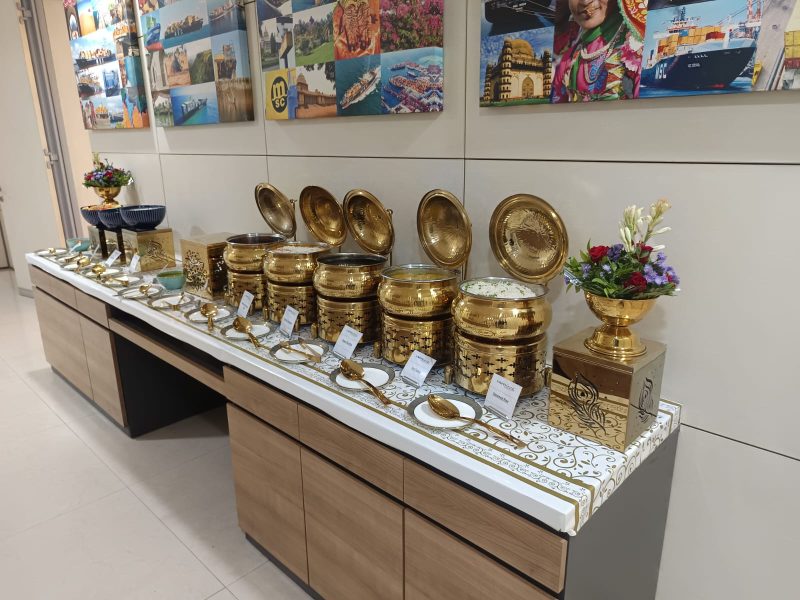
- Pre-plate or pre-box for any break under thirty minutes. A service line only works with forty-five minutes or more.
- Set up before the session ends, not when the break starts. Our team lays out while the meeting is still running, so the break begins with everything ready.
- Separate the drinks, as above.
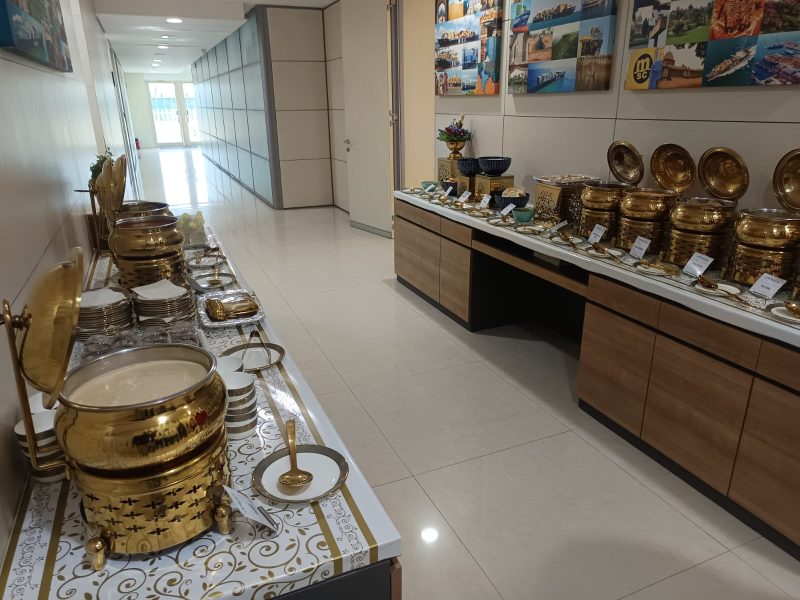
- Use two service points for anything above sixty people.
And plan the building access. In BKC and Colaba offices especially, vehicle passes, staff IDs and service lift bookings can take 24 hours. We submit those in advance rather than negotiating at the gate.
5. Consider Jain, vegetarian and vegan requirements
In a buffet setting, someone with a dietary requirement can quietly check and choose. In a meeting room with a plate already in front of them, they cannot — and asking in front of a client is awkward for everyone.
So meeting catering has to be labelled harder than any other format. Every item should carry its category in plain words:
- Regular vegetarian
- Jain — no onion, no garlic, no root
- Vegan — no dairy
- Low oil
- No chilli
- Nut-free
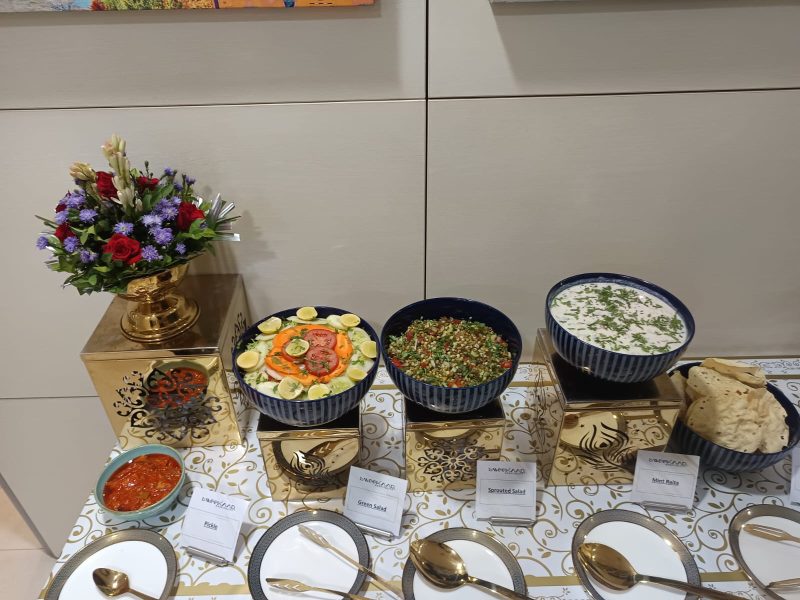
Vegan is the label most often applied wrongly. A vegetarian dish is not automatically vegan — paneer, ghee, curd, cream and butter run through most Indian menus, and a dish marked vegan containing any of them is worse than no label at all. Our vegan catering and pure veg catering pages set out how each is prepared.
One practical tip: over-provision the Jain and vegan portions slightly rather than matching an exact count. Running short in front of a client is not recoverable.
6. How much food do you need?
The usual mistake is ordering to the invite list rather than to who turns up.
Post-hybrid, attendance and headcount diverge sharply. For an internal meeting, plan for around 85% of those invited. For a client meeting, plan for 100% plus two — someone always brings a colleague nobody mentioned.
Beyond that:
- Under 90 minutes: refreshments only. A full meal is unnecessary and slows the session.
- Half day: one tea break plus a light lunch. Heavy food at one o'clock loses you the afternoon.
- Full day: morning tea, lunch, afternoon tea. Keep the lunch lighter than instinct suggests.
- Evening meeting: people are hungrier and eat more. Plan roughly 20% above a daytime equivalent.
7. When should you book business meeting catering?
A day's notice is comfortable for a standard meeting. Same-morning requests are often workable — our kitchen is in Marol, Andheri East, roughly twenty to thirty minutes from most Mumbai business districts outside peak traffic.
Book earlier when:
- The building needs vehicle passes or a service lift booking — 24 hours minimum
- It's a client or investor meeting where you want a tasting first
- It falls in festive weeks, when capacity across the city tightens sharply
- You need live counters, which require space planning and extra staff
Many of our office catering clients keep a standing arrangement for recurring board meetings, so nobody has to organise it each time.
8. Why choose Sweekaar Hospitality
We've been catering for Mumbai businesses since 2011, and meeting catering is a large part of what we do.
Our own kitchen
Everything is cooked in our FSSAI-certified kitchen in Marol, Andheri East. Nothing is subcontracted, so quality doesn't drift between one month and the next.
A named person
You get a contact who knows your floor, your headcount and your usual timing — not a call desk.
Access handled in advance
Vehicle details, staff IDs and lift bookings submitted before the day, not sorted out at your reception.
Come and see the kitchen
Your admin or HR team is welcome to visit before any recurring arrangement begins. Most corporate clients do, and we'd rather you did.
For the full picture of what we cover, see corporate catering in Mumbai.
9. In short
Decide the format first, then the menu. Keep the food simple enough to eat one-handed. Separate the drinks from the food. Set up before the break starts, not when it does. Label every dietary option in plain words. Order to attendance, not to the invite list. And sort the building access a day ahead.
Get those seven right and meeting catering stops being something that goes wrong.
Frequently asked questions
How much notice do you need for business meeting catering in Mumbai?
A day is comfortable. Same-morning requests are often workable because our kitchen is in Marol, Andheri East — twenty to thirty minutes from most Mumbai business districts outside peak traffic.
What is the smallest meeting you cater for?
A ten-person boardroom lunch is a completely normal request. There is no minimum that rules out a small meeting.
Can you serve within a twenty-minute break?
Yes, but only with pre-plated or boxed service and setup completed before the break begins. A buffet line cannot clear forty people in twenty minutes.
How much food should we order for a business meeting?
For an internal meeting, plan for around 85% of those invited. For a client meeting, plan for 100% plus two — someone usually brings a colleague nobody mentioned.
Do you handle building passes and lift bookings?
Yes. Vehicle details, staff IDs and service lift bookings are submitted in advance rather than negotiated on arrival.
Do you offer Jain and vegan options for meetings?
Yes, prepared separately and labelled clearly. Jain is cooked without onion, garlic or root vegetables. Vegan contains no dairy at all — no paneer, ghee, curd, cream or butter.
Can this run as a standing arrangement?
Yes. Many clients keep a standing arrangement for recurring board meetings and client visits, so nobody has to organise it each time.
Corporate catering across Mumbai
BKC Colaba Andheri Lower Parel Powai Goregaon Bandra Thane Navi Mumbai All corporate catering
Tell us the meeting type, headcount, break window and building. We'll come back with a format recommendation and a written quotation.
Request a quotation