

Corporate Cafeteria Contracts: What to Put in the Brief Before You Go to Tender
Most cafeteria briefs specify the food and leave out everything that actually determines whether the arrangement survives its second year. Here is what belongs in the document, and the questions that separate a vendor who can do this from one who will learn on your site.
If your financial year starts in April, your cafeteria review is a December-to-February job. Leave it to March and you are choosing from whoever still has capacity, negotiating under time pressure, and starting a multi-year arrangement without a trial. That is how companies end up re-tendering eighteen months later.
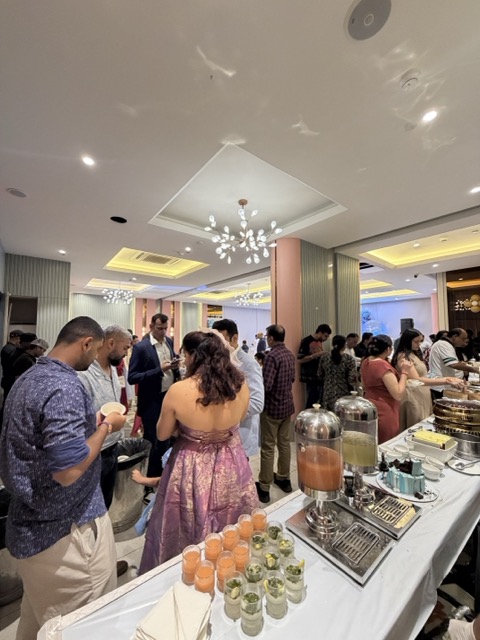
Cafeteria or canteen? The word tells you what you are buying
These get used interchangeably and they shouldn't be. In practice the vocabulary signals a different expectation.
| Canteen | Cafeteria | |
|---|---|---|
| Typical setting | Plants, factories, institutions, shift-based sites | Corporate offices, tech parks, MNC campuses |
| Priority | Volume, calories, speed, cost control | Variety, presentation, choice, dwell time |
| Service style | Fixed thali or set menu, served fast | Multiple counters, choice at point of service |
| Judged on | Reliability and hygiene | Reliability, hygiene and whether staff want to eat there |
That last row is the real difference. A canteen succeeds if nobody complains. A cafeteria succeeds if people choose it over going out — which is a harder brief and should be written as one.
What most briefs get wrong
The common mistake is specifying dishes when you should be specifying outcomes. A brief that lists sample menus gets you vendors competing on that list. A brief that states the operating reality gets you vendors competing on whether they can actually run it.
Any vendor can produce an impressive four-week sample menu. Very few can produce the median Tuesday in August, in year three.
Specify these instead
- Headcount range and variability. Not a number — the spread. What does a Monday look like versus a Friday? What happens in appraisal season, or when half the floor is travelling?
- Service windows. Exact hours, and how long the queue is allowed to be. "Lunch 12:30–2:30" and "no more than four minutes to be served" are different specifications.
- Dietary split. Approximate proportions for vegetarian, Jain, vegan and any fasting requirements. Whether these need separate counters and separate serving equipment.
- Menu cycle length. How many days before a dish may repeat. Four weeks is a reasonable floor; anything shorter gets noticed by month three.
- Review cadence. Who reviews the menu with the vendor, how often, and what evidence they look at.
- Hygiene documentation. What records must be kept, how long, and who can ask to see them without notice.
- Escalation route. Who an employee tells at 12:45 when something is wrong, and who the vendor's responsible person is by name.
- What the site provides. Kitchen or no kitchen, gas, power load, refrigeration, storage, staff facilities. Vendors quoting without this are guessing.
The subsidy model shapes everything downstream
Before anything else, settle how it is paid for, because it changes the vendor's whole incentive.
Fully company-funded
Employees eat at no cost. Uptake is high and predictable, so the vendor can plan volume accurately. The risk is waste, because nobody declines food they aren't paying for. Needs a headcount system that reflects reality.
Employee-paid
Staff pay at point of service. The vendor carries demand risk, so quality matters directly to their revenue — which is a useful alignment. But uptake is volatile, and on a quiet week the vendor loses money and starts cutting.
Subsidised hybrid
The company covers part, employees pay the rest. The most common arrangement in Mumbai corporates and usually the most stable, because both sides carry some of the risk.
Coupon or credit systems
Useful where attendance is irregular or the site has contractors as well as employees. Adds administration, so be clear who reconciles it and how often.
Compare the quotes properly
Quotes from different vendors are rarely comparable as written, because each one includes and excludes different things. Before you line them up, confirm for each:
- Whether staffing is included and at what headcount
- Whether equipment, crockery and consumables are included or hired
- Who bears the cost of waste, and how waste is measured
- What happens to the rate if your headcount moves outside the stated range
- Whether festival and special-occasion service is included or billed separately
- What the escalation clause looks like, and how often the rate can be revised
- Notice period on both sides, and what happens to the handover
Two quotes that look far apart often converge once these are equalised — and sometimes the cheaper one turns out to be the expensive one.
Red flags in a vendor response
- A quote produced without a site visit
- No trial period offered, or resistance when you ask for one
- Can't name their longest-running contract or how long it has run
- Vague about who will actually be on site day to day
- Hygiene documentation described as "available on request" rather than shown
- A sample menu with no cycle length stated
- No answer on what happens when headcount drops
- Jain and other dietary requirements described as "we can manage that" with no detail on separation
Insist on a trial, and run it properly
Two to four weeks of real service, with real headcounts, before the contract starts. A tasting shows you the best version of the food prepared by the best person available. A trial shows you the version that arrives on an ordinary Tuesday when nobody senior is watching.
Make the trial long enough for the menu to repeat at least once. That repeat is where you learn whether the cycle holds up, and it is the single most informative moment of the whole process.
A short checklist
- Start by December for an April handover. March is too late.
- Specify outcomes, not dishes. Service windows, queue times, cycle length, review cadence.
- Settle the subsidy model first. It determines the vendor's incentives.
- Equalise the quotes before comparing — inclusions vary enormously.
- Require a site visit before any quote is accepted.
- Run a real trial long enough for the menu to repeat.
- Name the people. Who is on site, who you escalate to, who reviews.
Common questions
When should we start the cafeteria review process?
For an April start, begin in December. The sequence is brief, shortlist, site visits, quotes, trial, contract — and the trial alone needs two to four weeks. Starting in March means skipping the trial, which is the step that tells you the most.
What's the difference between a cafeteria and a canteen contract?
Mostly expectation. A canteen succeeds if nobody complains; a cafeteria succeeds if staff choose it over going out. That means more counters, more choice at the point of service and a longer menu cycle — which should be written into the brief rather than assumed.
How long should a menu cycle be?
Four weeks is a reasonable floor for daily service. Anything shorter and people notice the repetition by month three, which is when most contracts start generating complaints. Specify the cycle length in the brief rather than leaving it to the vendor.
Do we need our own kitchen on site?
Not necessarily. Some sites have a working kitchen, some have a servery with food brought in, some have nothing at all. All three can work, but they produce very different quotes — which is why a site visit before quoting is non-negotiable.
How do we handle Jain, vegan and fasting requirements?
Specify the approximate proportions and require separate counters and separate serving equipment. In a kitchen that also prepares non-vegetarian food, ask precisely how separation is maintained. A fully vegetarian kitchen removes the question entirely, which is one reason some companies specify it.
What hygiene documentation should we be able to see?
FSSAI licensing, staff health records, temperature logs, pest control records and cleaning schedules — kept on site and available without notice, not produced on request a week later. Write the retention period and the inspection right into the contract.
Reviewing your cafeteria contract this year?
Tell us your headcount range, your site and your service windows. We will come and look before we quote — and tell you plainly if we are not the right fit.
Talk to usRelated: corporate cafeteria management, setting up a company cafeteria, industrial canteen services, institutional canteen services and catering or a canteen contract.


